















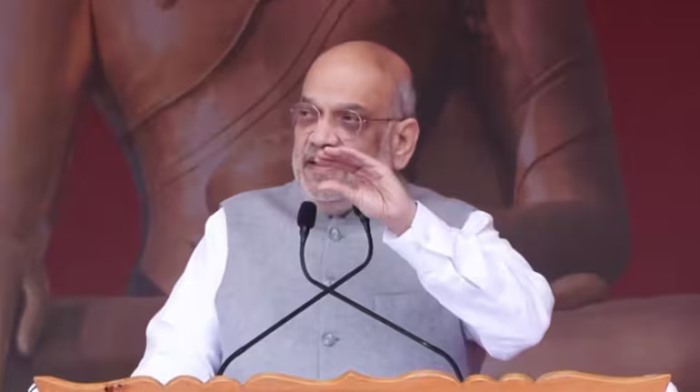
New Delhi, May 01, 2026: Union Home Minister Amit Shah on Friday outlined an ambitious push to strengthen the dairy ecosystem in Ladakh and Kargil, while also highlighting the broader transformation of India’s livestock sector and the cultural significance of the return of sacred relics of Gautama Buddha to the region after decades.
Addressing events in Leh and Kargil, Shah said the government is prioritising infrastructure that can support sustainable livelihoods for farmers in high-altitude regions. He announced that a milk processing unit with a capacity of around 50,000 litres per day will be established in Leh at an estimated cost of Rs 70 crore.
“We are also working to further strengthen infrastructure in Ladakh as well as in Kargil. In the coming days, a new dairy plant with a processing capacity of around 50,000 litres per day will be set up in Leh at an estimated cost of Rs 70 crore,” he said.
Alongside this, cattle breeding centres will be developed in both Leh and Kargil, each costing about Rs 4 crore. These centres will focus on introducing high-yielding breeds suited to local climatic conditions.
“Around 500 improved cattle are planned to be introduced annually, with a long-term goal of nearly tripling livestock numbers in the region over the next decade,” Shah stated.
He emphasised that research will be undertaken to ensure that livestock can survive in Ladakh’s extreme cold and low-oxygen environment. Over time, the addition of new animals and their offspring is expected to significantly expand the livestock base.
Strengthening procurement and cooperative networks
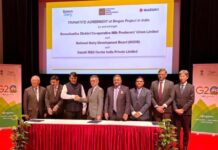
Shah said the dairy network in Ladakh has expanded following its integration with the National Dairy Development Board, with the milk federation now covering 28 villages. However, he stressed that this must extend to at least 85 per cent of villages where livestock farming is viable.
Daily milk procurement currently stands at about 6,000 litres, and he called for scaling this up to 21,000 litres in the coming years. He noted that expanding processing capacity and forming supply arrangements with the Indian Army would provide a reliable market for producers.
“Expansion of plant capacity — from 5 TLPD to 10 TLPD — and agreements with the Army will certainly be beneficial,” he said.
The minister also announced mobile milk testing units and a digital Automated Milk Collection System to improve transparency and efficiency in procurement.
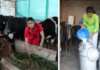
In Kargil, he said the foundation stone has been laid for a dairy processing facility with a capacity of 10,000 litres per day, at a cost of Rs 25 crore. He noted that local dairy units are already producing around 500 kg of paneer and 1,000 kg of curd daily, and that modernisation will improve efficiency further.
Shah highlighted that nearly 18,000 personnel from forces such as the Indian Army and the Indo-Tibetan Border Police are stationed in the region, creating strong demand for dairy products. He also praised the role of women in Kargil, saying the initiative would help them become self-reliant and improve household incomes according to the reports published in moneycontrol.com.
National dairy growth and policy push
Shah also pointed to significant national-level gains in the dairy sector under Prime Minister Narendra Modi. He said India’s milk production has risen from 143 million tonnes in 2014–15 to about 248 million tonnes in 2024–25, reflecting nearly 70 per cent growth over a decade.
“There has been a major transformation in the livestock and dairy sector across the country after Narendra Modi became Prime Minister in 2014,” he said.
He added that almost half of this growth has occurred in the last five years. Per capita milk availability has increased from 307 grams per day in 2014 to around 485 grams currently.
“Pasteurised milk plays an important role in meeting children’s nutritional needs,” Shah noted, expressing hope that Ladakh would also reach the national average of 485 grams per day.
Milk powder output has risen from 15,000 metric tonnes in 2014–15 to about 24,000 metric tonnes. He further said India now has over 2.36 lakh dairy cooperative societies with nearly 20 million producers linked to them.
The government aims to create 75,000 new dairy cooperatives within five years, of which more than 21,000 have already been formed, while around 46,000 existing societies are being modernised.
Buddha Purnima and return of sacred relics
During his visit, Shah also took part in celebrations of Buddha Purnima and inaugurated an exposition of sacred relics of Lord Buddha in Leh. He described their return after 75 years as a moment of deep historical and spiritual importance.
“These sacred relics have come to Ladakh after 75 years. It is as if Buddha himself is present here today,” he said.
He referred to Ladakh as a longstanding centre of Buddhist learning and compassion, noting its role in preserving teachings over centuries. “Ladakh has been a living land of dharma for centuries,” he said.
Highlighting philosophical teachings, Shah added, “Knowledge is incomplete without spiritual practice, while spiritual practice without knowledge is blind.” He stressed that moral discipline forms the foundation of a wise life.
He also noted that Buddhist teachings spread from India to other parts of Asia through regions including Ladakh, aided by ancient trade routes such as the Silk Route.
Shah said the message of peace and compassion remains highly relevant today. “Amid conflict and unrest, only the path of peace and compassion can provide solutions,” he said.
The minister urged authorities to ensure smooth arrangements for visitors of all faiths coming to pay respects to the relics.
He also praised the people of Ladakh and Kargil for their role in defending the country’s borders, saying that locals have historically shown courage in times of external threats.